


There is a lively discussion underway in the Polish internet about the safety of fixed-rate mortgages. One of the louder voices in this debate is Mr Krzysztof “Ator” Woźniak, who in his popular video posted on YouTube rightly draws attention to a potential risk that many call the “fixed-rate mortgage trap“.
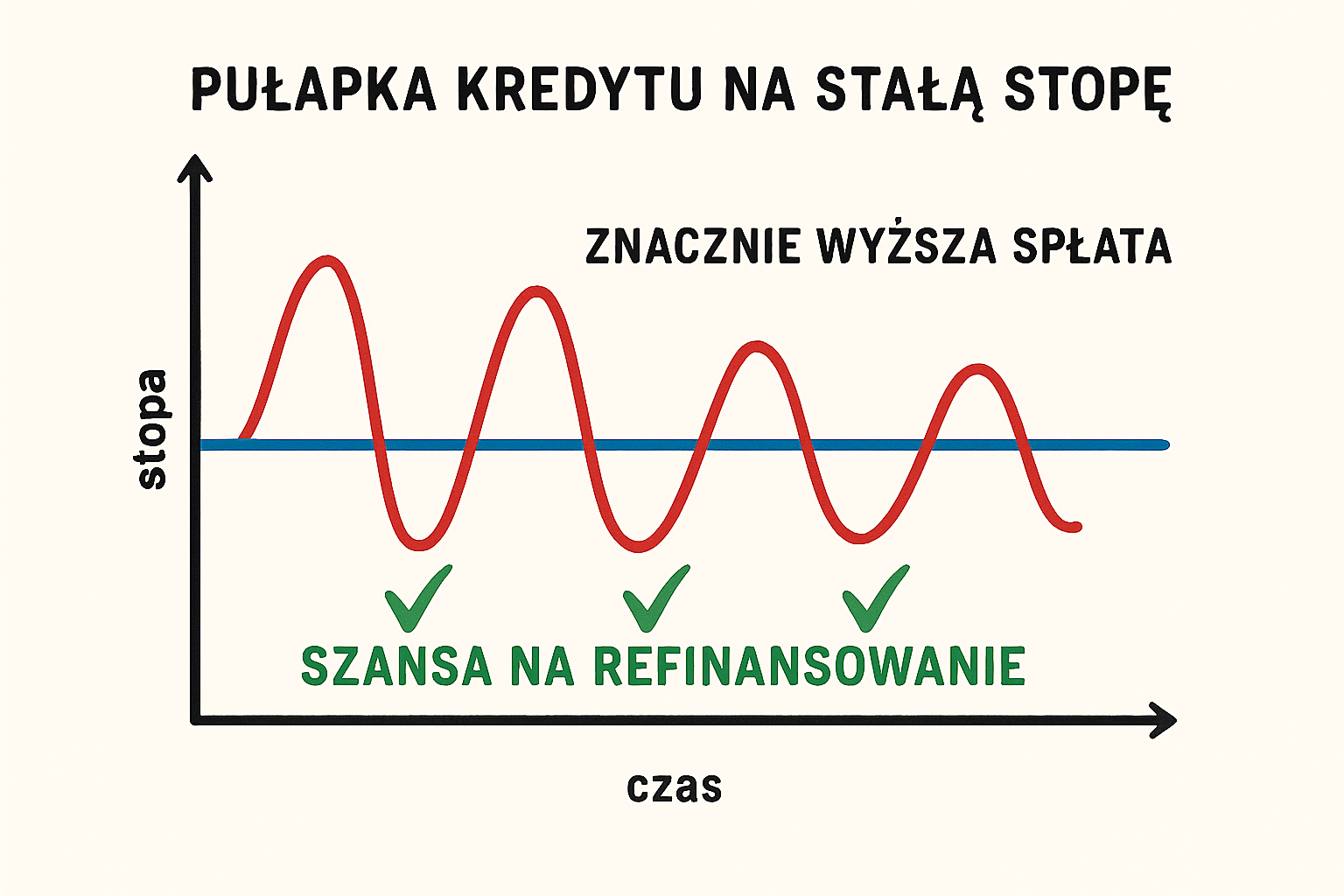
Ator precisely describes the mechanism in which banks, at the peak of interest rate hikes, massively encouraged clients to switch to a fixed rate. He argues that this was a deliberate strategy by institutions that knew rates would soon start falling. As a result, many borrowers got “trapped” with a high, fixed installment, while variable-rate loan installments started to decrease.
This is a real and justified concern. Mr Krzysztof Woźniak correctly diagnoses the problem, pointing out that the same clients, now trying to go back to a variable rate, are met with refusal. What’s more, refinancing such a loan at another bank into a variable rate is also problematic. His message is simple: a bank is not a charitable institution, and if it recommends something, it does so in its own interest.
Taking this important warning as our starting point, let’s go one step further. While the risk identified is real, and banks have indeed blocked an easy return to a variable rate, a strategic emergency exit exists. In the unpredictable environment of 2025-2026, a fixed-rate loan doesn’t have to be a cage – it can be a shield. For a proactive borrower, there is an effective and almost cost-free optimization strategy available with a financial expert, who takes care of the entire process by acting as an intermediary.
Economic Uncertainty, or Why Stability Comes at a Premium
The foundation of any decision about a multi-year obligation should be an assessment of the economic environment. Today, this landscape is characterized by unprecedented uncertainty, which makes cost predictability an absolute necessity.
On one hand, Goldman Sachs analysts predict that interest rates in Poland could fall to 3% by the second quarter of 2026. Forecasts from mBank (4.00% by the end of 2026) and PKO BP point in a similar direction. These scenarios, fueled by the first rate cuts in 2025, create a narrative of an inevitable decline in loan costs.
On the other hand, this optimistic picture is balanced by serious risk factors. Credit Agricole experts point out that the European Central Bank (ECB) may have finished easing monetary policy, and its next move at the turn of 2026 could be… a rate hike. Such a move in the eurozone would not leave Poland unaffected. On top of that, there is geopolitical uncertainty and inflationary pressure, which could force the Monetary Policy Council (RPP) to change course.
Interest Rate Risk – The Silent Enemy of the Household Budget
To fully understand why stability is so valuable, we need to define the key threat: interest rate risk. In the case of variable-rate loans (based on WIBOR or WIRON), this risk is transferred entirely to the borrower.
History provides striking examples. WIBOR 3M stood at 0.21% in 2021, but just 20 years earlier it reached around 17%. While a return to such values is unlikely, this shows that low rates are not a permanent state. Even smaller changes have a devastating impact on the budget. An increase in the interest rate from 4% to 6% for a loan of 300,000 zł over 30 years means the installment rising from about 1,432 zł to nearly 1,798 zł. That’s more than 360 zł per month.
Choosing a variable-rate loan is therefore, in effect, a conscious acceptance of unlimited financial risk.
The comparison below shows the fundamental differences between the two types of interest rates in terms of risk management.
| Feature | Variable-Rate Loan | Fixed-Rate Loan (periodic) |
| Risk Level | High and unlimited. | Low and limited. Risk of an installment change only after 5 years. |
| Installment Predictability | None. The installment can change every 1, 3, or 6 months. | Full. Guaranteed unchanged installment for 5 years. |
| Impact on the Budget | Destabilizing. | Stabilizing. Enables precise planning. |
| Potential Benefits | Possibility of a lower installment if rates fall. | No direct benefit from falling rates during the fixed-rate period. |
| Key Threat | A sudden, uncontrolled rise in the installment. | Risk of “overpaying” if market rates fall significantly. |
Where Did the “Trap” Come From? The Protective Role of the KNF
The source of the concerns about a “trap” is a specific regulation. On June 27, the Polish Financial Supervision Authority (KNF) issued a communication to banks in which it deemed unacceptable, among other things, offering to refinance fixed-rate loans into a variable rate before the end of the fixed-rate period (usually 5 years).
At first glance, this looks like a restriction of consumer rights. However, the KNF’s goal was to protect borrowers from… their own hasty reaction. The regulator identified a risk that the same clients who had recently fled variability could, tempted by the prospect of a quick drop in their installment, just as quickly go back to a variable rate, once again exposing themselves to the full risk. This restriction is meant to protect household budgets from excessive speculation.
Fixed Rate in 2025 – Weighing the Gains and Losses
Let’s analyze what we actually gain, and what we risk, by choosing a fixed rate today.
Predictability as a Financial Shield
The biggest advantage is predictability. As HRE Investments analyst Bartosz Turek aptly put it, choosing a fixed rate means “buying yourself peace of mind.” In uncertain times, the ability to precisely plan your largest monthly expense 5 years ahead is a value that’s hard to overstate.
This eliminates the biggest variable in the household budget. A family doesn’t have to anxiously wait for a new schedule every quarter. It provides a sense of control and acts like an insurance policy – protecting against the worst-case scenario.
Does Safety Have to Be Expensive? The Market Reality
One myth is the belief that you always have to pay dearly for the safety of a fixed rate. An analysis of market offers from October 2025 shows that this argument has become outdated. The price differences between the best fixed and variable offers have become minimal.
The Perceived Downside, or the Cost of Foregone Benefits
However, we must fairly present the main argument against a fixed rate: the risk of the opportunity cost. If market rates fall significantly during the 5-year period, the borrower won’t feel the benefit of a lower installment.
This risk is real. It’s the price you pay for the guarantee of stability. However, unlike the unlimited risk of a rising installment in a variable-rate loan, the risk of an opportunity cost is a fully manageable risk.
The Strategic Escape Hatch, or How to Actively Manage “Immovable” Debt
This is the key moment where we debunk the myth of being “trapped.”
Refinancing: Your Tool for Optimization
The answer to the risk of an opportunity cost is refinancing. It involves taking out a new loan at a different bank to pay off the existing one, but under new, more favorable terms.
The key fact is this: Mr Krzysztof “Ator” Woźniak is right that the KNF and banks prevent refinancing a loan from a fixed rate to a variable rate.
However, there is no obstacle whatsoever to refinancing such a loan into a new, lower fixed rate at a different bank.
So if you took out a loan with a fixed rate of 7%, and after two years new offers on the market propose a fixed rate of 5.5%, you can move the loan to a new bank and “lock in” a lower rate for the next 5 years. Importantly, this operation can be repeated. A fixed-rate loan stops being a 5-year decision and becomes a flexible instrument that can, and should, be optimized.
How Much Does Switching Banks Really Cost?
A common barrier is the belief that refinancing costs are high. In reality, they are low and predictable. The main costs are:
- Court fees: Registering the new mortgage (200 zł) and removing the old one (100 zł).
- Property valuation (appraisal report): Cost of 300 – 800 zł. Sometimes the new bank covers this cost or accepts an older valuation.
- Commission for granting the new loan: Potentially 1-3% of the loan value. This, however, is the main competitive factor. Many banks, wanting to attract clients, offer promotions with 0% commission.
- Early repayment compensation: Under the law, the bank has the right to charge compensation (up to 3%) during the fixed-rate period. This is a right, not an obligation. In practice, many banks waive this fee to stay competitive from the start. This must always be checked in the contract.
Below is a realistic cost calculation.
| Cost Element | Typical Cost | Notes and Potential Savings |
| Commission for the new loan | 1-3% of the loan | Often 0% in promotional offers. A key negotiation point. |
| Early repayment compensation | Up to 3% of principal | Many banks waive this fee. Check the contract. |
| Property valuation | 300 – 800 zł | Sometimes the bank covers this cost. |
| Court fee (registration) | 200 zł | Fixed cost. |
| Court fee (removal) | 100 zł | Fixed cost. |
| TOTAL (Optimistic scenario) | ~400 – 1,100 zł | Assumes 0% commission. The savings on the installment quickly cover this cost. |
As you can see, in a realistic scenario where we choose banks with promotions, the total cost of the operation comes to around 1,000 zł. If, thanks to refinancing, the monthly installment drops by 200 zł, the investment pays for itself after just 5 months.
The Active Borrower’s Strategy
Awareness that refinancing exists opens the door to an advanced strategy. In a dynamic environment, a proactive borrower doesn’t have to passively wait 5 years. With the help of an experienced financial expert, like Łukasz Turczyn from optymalizacjakredytowa.pl, you can monitor the market on an ongoing basis. If an offer appears that’s favorable enough that the interest savings exceed the low cost of the operation, you decide to “jump” to another bank.
The Verdict: Why 2025 Is the Ideal Moment to Choose a Fixed Rate
The synthesis of these arguments leads to a clear conclusion. Under current conditions, choosing a fixed-rate loan is the safer and more strategically rational decision.
The risk associated with a variable-rate loan is real, immediate, and unlimited. A sudden rise in rates can destabilize your financial liquidity. On the other hand, the risk associated with a fixed rate (namely “overpaying” when rates fall) is only potential and, most importantly, fully manageable through a strategy of regularly refinancing into new, more favorable fixed terms.
On top of that, the historical “safety premium” has practically disappeared. As the analysis shows, fixed offers are competitively priced today. The barriers related to refinancing are low, and the operational costs are minimal.
It is far more sensible to choose predictable debt that can be actively managed than to passively submit to unpredictable risk.
Change Your Perspective – Your Mortgage Is an Investment in Peace of Mind
Mr Krzysztof “Ator” Woźniak‘s warnings are valuable, because they remind us that a bank acts in its own interest. The real trap nowadays, however, is passivity, making decisions based on fear, and risky speculation.
A fixed-rate loan is the foundation of stability. It’s a shield that protects your budget. At the same time, thanks to the mechanism of refinancing into a new, lower fixed rate, it’s a flexible instrument. It can be regularly improved, avoiding being “trapped.”
The decision about a mortgage loan is one of the most important in life. It’s not worth making it alone. If you want to analyze your situation, evaluate the available offers, and create a personalized strategy that turns an apparent trap into an advantage – get in touch with us.
My name is Łukasz Turczyn, and I specialize in optimizing mortgage and cash loans.
Call me at: 888 333 728 or visit optymalizacjakredytowa.pl to schedule a free analysis of your contract, creditworthiness, or potential loan offers.
Komentarze