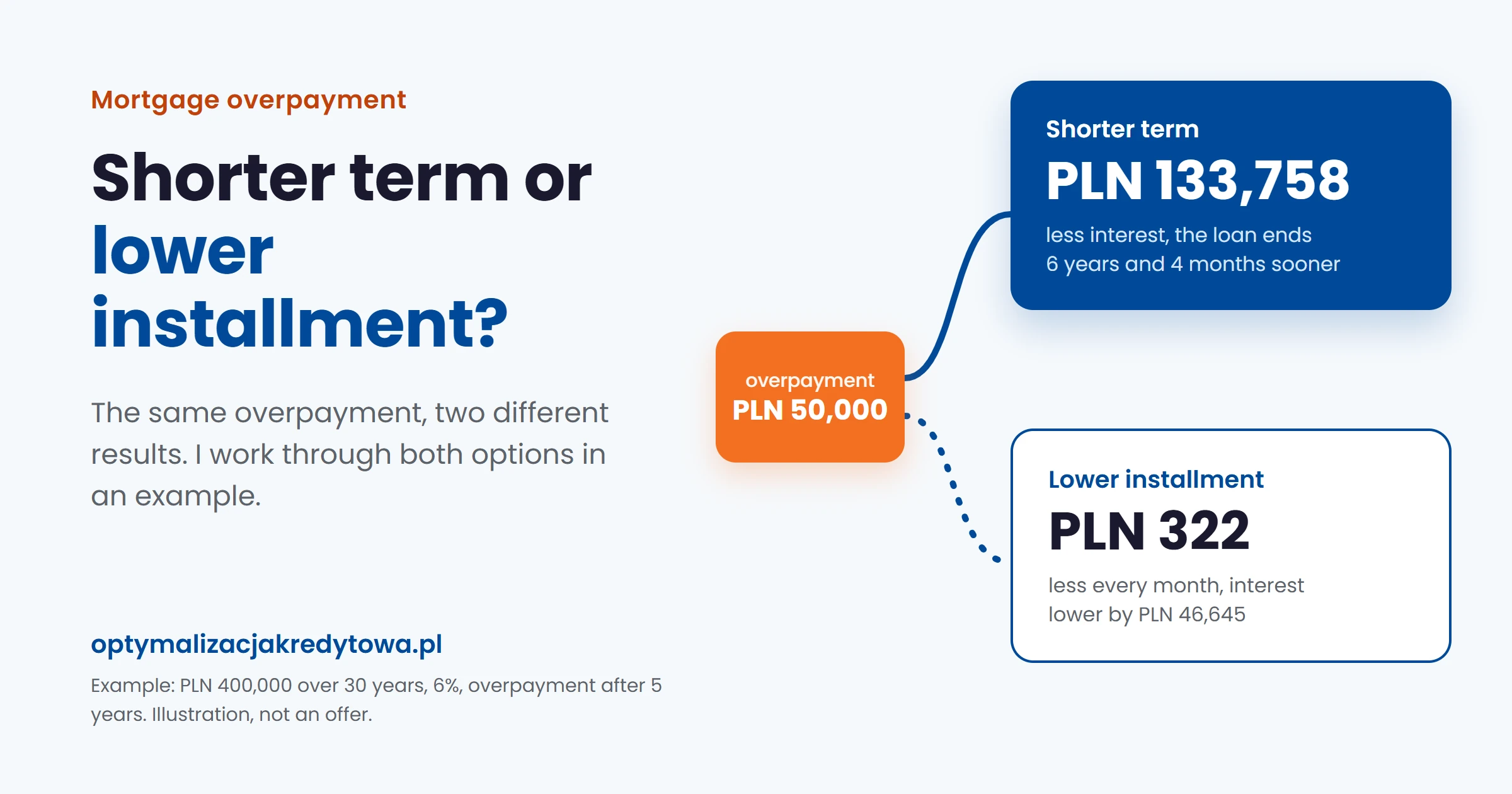
If you want to pay the bank as little interest as possible, choose a shorter term. If breathing room in your household budget or your creditworthiness before another loan matters more, choose a lower installment. The difference is large. On a PLN 400,000 loan over 30 years, an overpayment of PLN 50,000 after 5 years of repayment cuts interest by about PLN 133,800 if you shorten the term, and by about PLN 46,600 if you lower the installment. In the second option, the installment drops by about PLN 322 a month. Below I show the full calculation, the fees the bank may charge, and the situations in which an overpayment is not the best move.
All the numbers in this article are an illustration, not an offer or today’s interest rate: a loan of PLN 400,000 over 30 years (360 equal installments), an interest rate of 6% for the whole term, with no commission, insurance or other costs.
What does a PLN 50,000 overpayment give you? A worked example
Assumptions of the example:
- a loan of PLN 400,000 over 30 years, equal installments, interest rate 6% a year, interest calculated monthly,
- the installment is PLN 2,398.20,
- after 5 years (60 installments), PLN 372,217.58 is left to repay, with 300 installments to the end of the agreement,
- right after the 60th installment, you pay PLN 50,000 as an overpayment,
- the loan has a variable rate and more than 36 months have passed since the agreement was signed, so the bank does not charge compensation for the overpayment (more on fees below),
- in the shorter-term option, the last installment is lower than the others (PLN 905.99), because it only repays the tail end of the debt.
| Option | Interest from the 61st installment to the end |
|---|---|
| No overpayment: installment PLN 2,398.20, 300 installments to go | PLN 347,244.52 |
| Shorter term: installment PLN 2,398.20, 224 installments to go, i.e. 6 years and 4 months sooner | PLN 213,487.01, PLN 133,757.51 less |
| Lower installment: installment PLN 2,076.05, PLN 322.15 less, 300 installments to go | PLN 300,599.17, PLN 46,645.35 less |

Why such a big difference? When you shorten the term, you keep paying the full installment, so the debt shrinks faster and interest is charged on an ever smaller amount. When you lower the installment, the bank spreads the smaller debt over the same 300 months and you repay it more slowly. In the example, each zloty of overpayment saves about PLN 2.68 in interest with a shorter term and about PLN 0.93 with a lower installment.
With a variable-rate loan, the interest rate will not stand still for 25 years, so the amounts in your loan will be different. The order of the options does not change: with the same overpayment and the same fees, shortening the term always gives less interest than lowering the installment. I explain what drives a variable installment on the POLSTR vs WIBOR page (in Polish).
When is it better to lower the installment?
The lowest interest is not the only goal. A lower installment is worth choosing when:
- you are planning another loan or a joint loan with another person: the bank calculates creditworthiness by comparing the installments of all your obligations with your income, so a lower installment leaves more room for a new loan (more in the guide to building creditworthiness),
- your income is irregular or you expect it to fall, e.g. because of parental leave, a change of job or a switch to self-employment,
- you have a variable-rate loan and want a margin in case the installment rises.
There is also a way that combines both options. You choose the lower installment, but keep paying the same amount each month as before, and pay the difference as an overpayment that shortens the term. In the example, at a constant 6%, that is PLN 322.15 a month on top of the new installment. The result: the loan ends after the same 224 installments, and the interest is the same as with a shorter term, to the grosz. With a variable rate, the installment and the difference will change, but the rule stays: in total you pay what the installment would be in the shorter-term option. The difference is that in a harder month you can stop the extra payments and the installment stays lower. The condition: the bank does not charge fees for such overpayments and lets you choose a shorter term for each of them. In the first 36 months of a variable-rate loan and during a fixed-rate period, the bank may charge compensation on each of these extra payments. The chapter of the Polish Mortgage Credit Act on early repayment does not say who chooses the option, so check the rules in your agreement or the bank’s terms and conditions.
Can the bank charge a fee for an overpayment?
You have the right to repay the whole loan or part of it early at any time. The bank may charge compensation for this only if it is written into the agreement, and only within the limits of the Mortgage Credit Act (Art. 38 and 40). In every case, the compensation cannot be higher than the bank’s costs directly related to the early repayment. On top of that, there are limits that depend on the type of rate:
- variable rate: compensation is possible only for repayment within 36 months of signing the agreement. It cannot exceed 3% of the amount repaid or the interest that would accrue on that amount over a year. With an overpayment of PLN 50,000 and an interest rate of 6%, that is at most PLN 1,500, because 3% is PLN 1,500 and a year’s interest is PLN 3,000; less if the bank’s costs are lower. After 36 months there is no compensation,
- fixed rate: the bank may charge compensation for the whole fixed-rate period, which under Recommendation S of the Polish Financial Supervision Authority (KNF) should last at least 5 years. The act gives no percentage limit here; only the bank’s costs limit applies.
If you have a fixed rate and are planning a large overpayment, check when the fixed-rate period ends. An overpayment right after it may cost less than during it. I write more about how a fixed rate works and what happens after 5 years in the guide fixed or variable interest rate.
You don’t have to guess how much you will pay. At your request, the bank must provide, within 7 business days and on a durable medium, information on the cost of early repayment together with the assumptions of the calculation. It cannot make accepting the overpayment conditional on providing this information, so you can also overpay without it.
When the whole loan is repaid early, its total cost is reduced by the interest and other costs falling on the period by which the agreement was shortened, including those paid earlier. When part of the loan is repaid, this provision applies accordingly (Art. 39).
These rules apply to mortgage loans taken out by consumers under agreements concluded from 22 July 2017, when the act came into force. For older agreements, the fees for overpayment are governed by the agreement and the previous rules.
Overpay once or every month?
Both work. What counts is the amount and the timing. The same example, but instead of a single payment of PLN 50,000, you pay an extra PLN 500 a month from the 61st installment, each time shortening the term:
- the loan ends after 207 installments instead of 300, i.e. 7 years and 9 months sooner,
- interest from the 61st installment falls from PLN 347,244.52 to PLN 224,937.54, i.e. by PLN 122,306.98,
- over this time you pay PLN 103,000 in overpayments.
Timing matters, because interest grows fastest at the beginning, when the debt is highest. The same PLN 50,000 overpayment with a shorter term:
- after 12 installments reduces interest by about PLN 173,400,
- after 60 installments by about PLN 133,800,
- after 240 installments by about PLN 33,500.
Regular overpayments have one advantage: you don’t have to wait until you have saved a large amount. Just check that the bank does not charge a fee for each payment and that an overpayment made in the app does not lower the installment automatically when you want to shorten the term.
When is an overpayment not the best move?
An overpayment cannot be undone. The money only comes back to you as lower interest, and to have it in cash again you would need a new loan. So before you overpay, check four things:
- Financial cushion. Keep a reserve for a few months of expenses. An overpayment that leaves you with nothing to pay for a car repair can end in more expensive debt.
- More expensive debts. If you have a cash loan, a credit card or an overdraft with a higher interest rate than your mortgage, every zloty paid towards that debt saves more interest. If you have several such obligations, consider loan consolidation (in Polish).
- Interest rate at another bank. A lower interest rate works on the whole debt, an overpayment only on part of it. If another bank offers you clearly better terms, mortgage refinancing (in Polish) may give you more than an overpayment, and the two moves can be combined: when you move the loan, you pay part of it from your savings and borrow less at the new bank. I calculate the costs of switching banks in the post on the fixed-rate mortgage trap.
- Compensation. In the first 36 months of a variable-rate loan and during a fixed-rate period, an overpayment may cost money. Ask the bank for a calculation first.
How to overpay a mortgage step by step?
- Find the early repayment provisions in your agreement and the bank’s terms and conditions: compensation, how to order an overpayment (app, application, branch) and the choice between a shorter term and a lower installment.
- If the agreement provides for compensation, submit a request for information on the cost of early repayment. The bank has 7 business days to reply.
- Decide what you want: the lowest interest (shorter term) or a lower installment. If in doubt, calculate both options on your own numbers.
- Order the overpayment and indicate the chosen option.
- Once the payment is booked, download the new repayment schedule and check that the right thing has changed: the number of installments or the installment amount.
Frequently asked questions
Can a fixed-rate loan be overpaid too?
Yes. You have the right to repay all or part of the loan early at any time, also during the fixed-rate period. The bank may then charge compensation if the agreement provides for it, but not higher than its costs directly related to the repayment.
How long do you wait for the calculation of the overpayment cost?
The bank has 7 business days from receiving the request. It provides the information on a durable medium, e.g. in a PDF file or on paper, together with the assumptions it used for the calculation.
Does the interest in the following installments fall after an overpayment?
Yes. Interest is calculated on the principal left to repay, so after an overpayment each following installment contains less interest. With a shorter term, the installment does not change, but a larger part of it repays the principal. With a lower installment, the whole installment falls.
What about decreasing installments?
The principle is the same. After an overpayment, depending on the agreement and your choice, the bank reduces the principal part of the following installments for the same term, or leaves it unchanged and shortens the term. Shortening the term saves more interest; reducing the principal part gives lower installments.
I’ll calculate the overpayment on your numbers
Every loan is different: the interest rate, the fixed-rate period, the compensation clauses, and sometimes a better offer at another bank. During a free consultation, I will calculate what an overpayment would give you in both options, compare it with refinancing, and check how your creditworthiness will change if you are planning another loan. You can compare the result with the creditworthiness calculator or with the description on the creditworthiness page (in Polish).
Call or write, and we will analyze your situation.
Last content update: 20 November 2026. This article is for information only and is not an offer. The numerical examples are an illustration with an interest rate of 6% for the whole term. The terms of the loan and of the overpayment depend on the bank and your agreement, which is why I check them during the analysis.